
Rights Theory, Libertarianism
Libertarianism, Self-Defense, and Innocent Shields
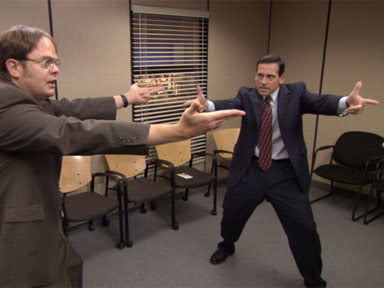 Suppose A is unjustly attacking V, and using I as an “innocent shield.” In other words, A has positioned himself (or I) in such a way as to make it difficult for V to employ defensive force against A without endangering I in the process. In circumstances such as these, is it morally permissible for V to employ defensive force against A, knowing that I might very well be harmed or killed as a result?
Many people think that it is, so long as V is not trying to harm I, but merely acting in a way that he foresees is likely to harm I as a side effect of his intended goal. This, at any rate, is what the doctrine of double effect says.
But even on the doctrine of double effect (which, of course, is quite controversial), V‘s causing harm to I is only permissible if V‘s action meets certain conditions of proportionality and necessity. V isn’t allowed, presumably, to shoot and kill I in order to prevent A from scratching V‘s arm. And V might not be permitted to kill ten I‘s in order to prevent one V from dying. Necessity is trickier. If there is one and only one possible way for V to stop A, and that way involves subjecting I to risk of harm, then the necessity is obvious. But reality is rarely so neat. Usually there will be multiple ways in which V might try to stop A, some of which are harder (costlier) and some of which are easier. Suppose (to over-simplify once again), that V has just two options. (1) V can attack A in a way that subjects V to very low risks of harm, but subjects I to a very high risk of harm. Or (2) V can attack A in a way that subjects V to a very high risk of harm, and I to a very low risk of harm. Is (1) necessary?
Here’s another puzzle, which I borrow from Robert Nozick. Suppose we decide that, in a certain case, V acts permissibly in attacking A and subjecting I to risk of serious harm or death. Suppose further that I is incapable of attacking A, but that I is capable of attacking V and thus preventing V from acting in a way that threatens I. Is it morally permissible for I to attack V in self-defense? Would this mean that I and V might both legitimately attack each other, both in self-defense?
I raise these questions as a way of putting a philosophical spin on our recent discussion of the conflict in Gaza. I stayed out of that discussion for the most part, but became more interested in it after engaging in some conversation with some of our readers on our Facebook page about Anthony Gregory’s provocative article. Gregory thinks Hamas is acting wrongly when it kills innocent Israelis. But he also thinks Israel is acting wrongly when it kills innocent Palestinians. In response, many defenders of Israel noted that Hamas uses Palestinian civilians as innocent shields, and moved pretty quickly to the conclusion that therefore Israel is blameless in causing the deaths of those civilians. Maybe that conclusion is right. But I don’t think it’s as obvious or unproblematic as a lot of people have assumed.
There’s quite a large philosophical literature on these questions, and a surprisingly small libertarian one. The philosophical literature is dominated by the likes of Judith Thomson and Francis Kamm, but see this paper for an overview of some relatively recent work in the field. As for the libertarians, I haven’t seen much apart from a mention of the innocent shield problem by Murray Rothbard, and a interesting discussion here from Walter Block. As I’ve noted before, the libertarian literature is also surprisingly disconnected from the philosophical one, to the detriment of both. I’m not at all convinced that the kind of intuition-driven deontology that Kamm and Thomson employ is the best way of thinking about these matters. But whatever the flaws of their method, they ask and try to answer challenging questions about what a a principle of non-aggression commits one to, in a way that too many libertarians gloss over or ignore.
UPDATE: Of course, whenever I say “there is some issue X that libertarians ought to think more closely about” this should be read as including an exception for Eric Mack, who most likely already has thought closely about it, and written something pretty good. See, for instance, his “Three Ways to Kill Innocent Bystanders” in Social Philosophy and Policy 1985, pp.1-26, and also his “Rights, Just War, and National Defense,” in Machan and Rasmussen eds. Liberty for the Twenty-First Century (Rowman & Littlefield, 1995). Neither is available online, unfortunately.